.svg)
.svg)


Hyperliquid AI: How Autonomous Trading Agents Are Changing Perps
What is Hyperliquid AI? Learn how autonomous trading agents use AI to build, monitor and execute perpetual trading strategies on Hyperliquid 24/7.
August 11, 2026
6
min to read

Introduction
Hyperliquid has helped move perpetual trading onchain. AI is beginning to change what traders can do once they're there. Traditional trading automation is built around predefined rules: when a specific condition happens, execute a specific action. AI trading agents add another layer by making it easier to create, manage and interact with those automated strategies.
Instead of writing code or manually configuring every workflow, traders can increasingly describe what they want to automate in natural language, test the resulting strategy and let an agent monitor the market and execute it continuously.
This emerging combination of Hyperliquid + AI + autonomous execution is creating a new way to interact with perpetual markets.
What is Hyperliquid AI?
Hyperliquid AI refers to the use of artificial intelligence and autonomous trading agents to research, create, monitor and execute trading strategies on Hyperliquid. Rather than requiring a trader to manually monitor every market condition or program a trading bot from scratch, an AI trading agent can act as the interface between the trader's strategy and the market.
A trader might describe an objective such as:
Buy ETH after a short-term pullback, but only while the broader trend remains bullish. Exit when momentum recovers and protect the position with a stop loss.
The AI can help translate that intent into a structured strategy, while the automation layer continuously monitors the required conditions and executes when they are met. In other words, the trader defines what they want to achieve; the agent helps turn it into something executable.
From trading bots to autonomous trading agents
Trading automation isn't new. Traditional bots have been used for years to execute predefined strategies across crypto markets. A developer writes a set of rules, connects the software to an exchange and lets the bot execute those instructions automatically. That model remains useful, but it comes with limitations.
Building sophisticated systems often requires:
- Programming knowledge
- API integrations
- Strategy logic
- Infrastructure
- Continuous monitoring
- Maintenance
AI agents change the interface. Instead of requiring every trader to become a developer, natural language can become the starting point for creating and managing an automation. The evolution looks something like:
Manual Trading → Rule-Based Bots → AI Trading Agents
The strategy doesn't disappear. The process of turning that strategy into an automated system becomes considerably more accessible.
Why AI agents fit perpetual markets
Perpetual markets are particularly well suited to automation because they're continuous, fast-moving and highly data-driven.
Markets run 24/7
There is no closing bell. An opportunity on ETH, BTC or another perpetual market can appear while a trader is sleeping or away from the screen. An autonomous agent can continue monitoring the strategy's conditions regardless.
Traders can go long and short
Perpetuals allow strategies to respond to both bullish and bearish conditions. An agent can therefore be configured to enter long positions when bullish conditions align, short positions when momentum reverses, or switch between the two depending on the strategy.
Conditions change quickly
Price, momentum, volatility and technical indicators can change within minutes. Automation allows a predefined strategy to react when its conditions occur rather than when the trader happens to notice them.
Strategies can become increasingly complex
A simple automation might watch one indicator. A more advanced setup could require:
- RSI below a specified threshold
- EMA20 above SMA50
- Volatility within a chosen range
- A minimum price movement
- Specific take-profit conditions
- Stop-loss protection
The more variables a strategy uses, the harder it becomes to monitor manually.
What can AI agents automate on Hyperliquid?
There isn't one specific "AI strategy." AI agents can be used to create and execute many different trading approaches depending on the trader's objectives.
For example:
Mean Reversion
An agent can monitor RSI, Bollinger Bands or other indicators for signs that price has moved unusually far from recent levels.
Trend Following
Moving averages and other trend indicators can be combined to identify sustained bullish or bearish momentum.
Momentum Breakouts
Agents can watch for sudden price expansions and enter when momentum conditions confirm a potential breakout.
Perpetuals Scalping
Short-timeframe strategies can monitor frequent opportunities and execute long or short positions according to predefined signals.
Multi-Condition Strategies
Several indicators can be combined into a single automation so that a trade only occurs when all required conditions align. And traders aren't limited to predefined templates. The asset, indicators, timeframe, position size, entry logic, exit conditions and risk parameters can all form part of the strategy.
AI trading agents vs traditional Hyperliquid bots
The biggest difference isn't necessarily what trade gets executed. It's how the trader creates and interacts with the system.
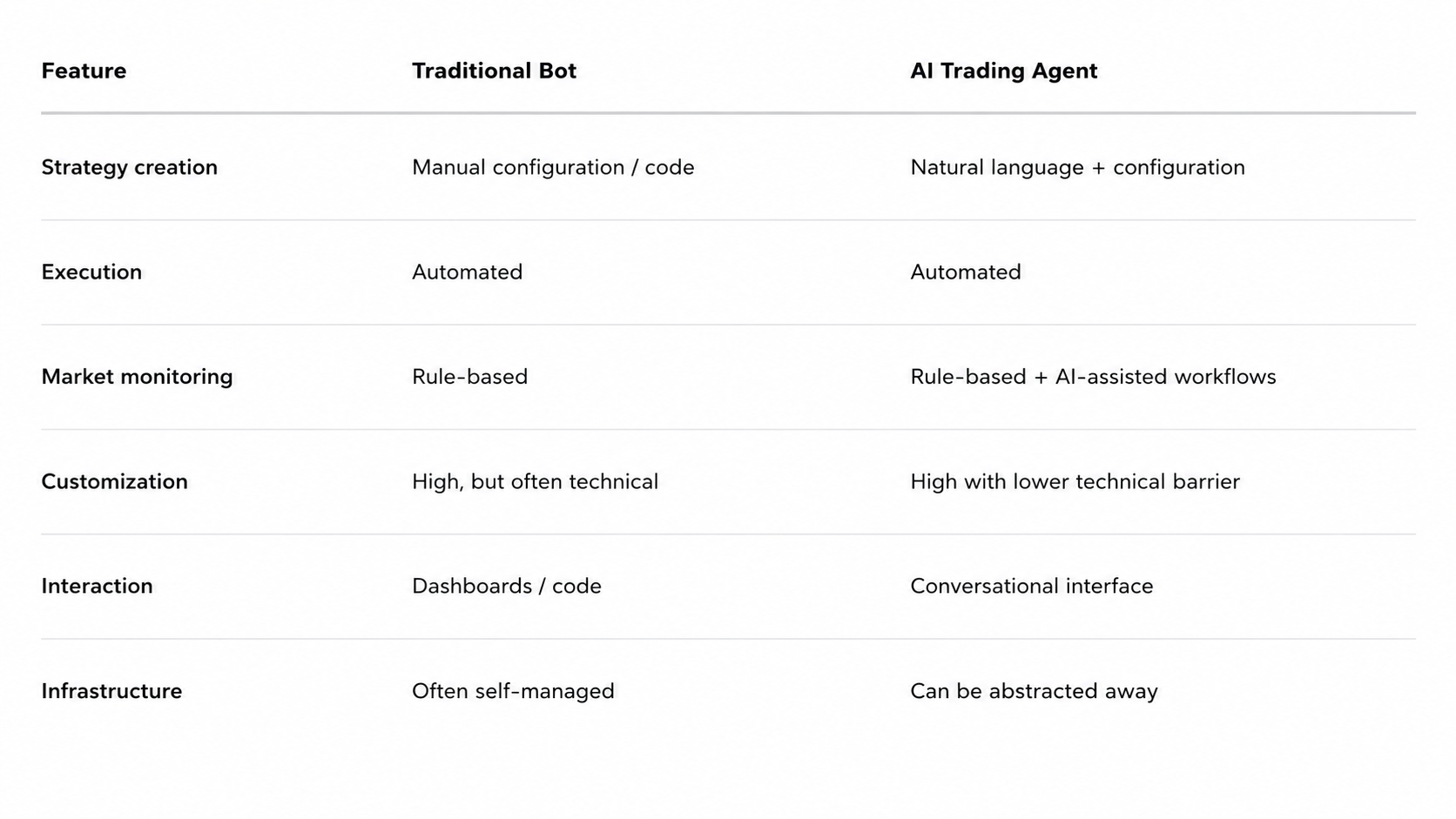
An AI agent shouldn't be understood as software that simply "guesses" whether a token will go up or down. A more useful model is:
Trader intent → AI interpretation → Structured strategy → Automated execution
That distinction matters.
Does the AI decide what to trade?
It can, but it doesn't necessarily have to. There are different levels of autonomy. At one end, a trader can define almost everything:
Trade BTC. Use this indicator. Enter at this threshold. Exit here. Never risk more than this amount.
The AI primarily helps translate and automate those instructions. At the other end, an agent can potentially be given broader objectives and more freedom to research markets, evaluate conditions and determine how to act within predefined boundaries. This creates a spectrum:
Trader-controlled automation ←→ Autonomous agent
For many traders, the most useful approach sits somewhere between the two: the trader controls the strategy and risk parameters while the agent handles continuous monitoring and execution.
AI doesn't remove the need for a strategy
This is an important distinction. Adding AI to trading software doesn't automatically make a strategy profitable.
An autonomous agent can:
- Monitor markets continuously
- Process multiple conditions
- Execute consistently
- Reduce manual workload
- Help translate ideas into strategies
But the underlying strategy still matters. A poorly designed strategy can still lose money when automated perfectly. Market conditions also change. A mean-reversion setup that performs well in a ranging market can struggle during a strong trend, while a momentum strategy can behave very differently when volatility disappears. AI improves what can be automated. It doesn't eliminate trading risk.
Backtesting before giving an agent capital
One way to evaluate an automated strategy before deploying it is through backtesting. Backtesting applies the strategy's rules to historical market data to examine how the setup would have behaved previously. Useful metrics can include:
- Historical return
- Number of trades
- Win rate
- Maximum drawdown
- Performance across different periods
Historical performance doesn't predict future results, but backtesting gives the trader more information than deploying an untested idea immediately. From there, the strategy can be modified, tested again or deployed if the trader is comfortable with its behavior.
What Hyperliquid AI looks like with Ethy
Ethy approaches Hyperliquid AI as an AI trading assistant with autonomous execution. Rather than requiring users to build trading infrastructure themselves, traders can interact with the strategy layer directly. There are several ways to do this.
Create a strategy through chat
A trader can describe what they want to automate in natural language, including the asset, conditions, timeframe and risk parameters. Ethy translates those instructions into an executable strategy.
Backtest it
The strategy can be tested against historical data before capital is deployed. This allows traders to evaluate and modify the setup before deciding whether to put it live.
Deploy it
Once ready, the strategy can be deployed and Ethy continuously monitors the relevant market conditions and executes according to its logic.
Start from an existing strategy
Not every trader needs to build from scratch. Users can also choose existing strategies and deploy them directly.
Copy proven live strategies
Traders can discover strategies that are already running, examine their tracked performance and copy them with their preferred allocation. This means the starting point can be:
Create → Backtest → Deploy
or simply:
Discover → Copy → Deploy
From AI assistant to autonomous execution
The broader shift happening in trading isn't simply that AI can provide more market information. AI systems have been able to summarize news, explain indicators and analyze markets for some time. The more important change is the move from answering → acting.
An AI assistant might tell you:
ETH's RSI has entered oversold territory.
An autonomous trading agent can be instructed:
If ETH becomes oversold while the broader trend remains bullish, enter according to my strategy and manage the position until my exit conditions are met.
That's a fundamentally different role. The first provides information. The second connects intelligence with execution.
Could autonomous agents trade without constant human input?
Technically, that's precisely what automation enables. Once a strategy and its boundaries have been established, an agent can continuously monitor markets and execute without requiring the trader to approve every individual action. But autonomy doesn't have to mean unlimited discretion.
Traders can still define constraints around:
- Capital allocation
- Position size
- Assets
- Leverage
- Stop losses
- Strategy conditions
- Maximum exposure
This makes it possible to delegate execution while maintaining boundaries around what the agent is allowed to do.
The future of AI trading on Hyperliquid
The first generation of crypto trading interfaces was manual. The next introduced bots and APIs. AI agents could make the next interface conversational and increasingly autonomous. Instead of navigating multiple tools to research a market, build a strategy, configure execution and monitor positions, traders could increasingly express the outcome they want and let software coordinate the underlying workflow.
That doesn't mean every trading decision will or should be delegated to AI. It means the barrier between having a strategy and running that strategy continuously is getting smaller. For perpetual markets that operate 24/7, that distinction is particularly important.
The shift from trading tools to trading agents
The interesting part of Hyperliquid AI isn't simply adding an AI chatbot to a trading interface. It's giving software the ability to move further along the trading workflow:
Understand → Build → Backtest → Monitor → Execute → Manage
That turns AI from something traders consult into something capable of helping operate their strategies. With Ethy, traders can define what they want to automate, choose the assets and conditions they want, backtest their setup, deploy it or copy an existing live strategy. The trader still decides what they want to trade and how much risk they're willing to take. The agent takes care of making sure the strategy doesn't stop when the trader closes the screen.
Frequently Asked Questions
What is Hyperliquid AI? Hyperliquid AI generally refers to using AI-powered tools or autonomous trading agents to research, create, monitor or execute trading strategies on Hyperliquid.
Can AI trade on Hyperliquid? Yes. AI trading systems can be connected to execution infrastructure that allows them to monitor market conditions and execute predefined strategies on Hyperliquid.
What is a Hyperliquid AI agent? A Hyperliquid AI agent is software that combines AI capabilities with trading automation, allowing it to help create, monitor and execute strategies on Hyperliquid with varying levels of autonomy.
Is an AI trading agent the same as a trading bot? Not exactly. Traditional bots generally execute explicitly programmed rules. AI agents can add capabilities such as natural-language interaction, strategy creation and more flexible orchestration while still relying on structured execution logic.
Can AI agents trade Hyperliquid perpetuals automatically? Yes. Once configured and connected to execution infrastructure, an agent can monitor perpetual markets continuously and execute long or short positions according to the strategy it has been given.
Are autonomous trading agents profitable? Autonomy does not guarantee profitability. Results depend on the quality of the strategy, market conditions, execution, fees and risk management. AI can improve automation and reduce manual execution, but trading risk remains.




.svg)
Your AI trading assistant.
Working 24/7 so you don't have to.

.svg)