.svg)
.svg)


Hyperliquid Strategies: 6 Automated Setups Traders Use
Discover six proven Hyperliquid trading strategies that traders automate using AI. Learn how, RSI, momentum, grid trading and other strategies can run 24/7 on Hyperliquid.
August 7, 2026
5
min to read

Introduction
Hyperliquid has become one of the fastest-growing perpetual trading platforms, giving traders access to deep liquidity and a wide range of perpetual markets. As the ecosystem matures, many traders are moving beyond manual execution and looking for ways to automate their strategies.
The challenge isn't finding opportunities—it's monitoring markets 24 hours a day and executing consistently without emotion. That's why more traders are turning to AI-powered trading assistants that can monitor markets continuously and execute predefined strategies automatically.
In this guide, we'll look at six of the most popular Hyperliquid trading strategies and explain how each one can be automated.
What are Hyperliquid trading strategies?
Hyperliquid trading strategies are predefined approaches traders use to decide when to enter, manage and exit positions on Hyperliquid.
Some strategies focus on buying market pullbacks, others look for momentum breakouts, while some simply accumulate positions over time. The common goal is to remove emotional decision-making by following consistent rules.
Modern AI trading assistants can automate many of these strategies, allowing them to run continuously without requiring traders to watch the markets all day.
1. RSI Reversion on $SAGA
Best for: Trading short-term oversold and overbought conditions.
RSI mean reversion is based on the idea that unusually strong price moves often correct back toward more typical levels. The Relative Strength Index (RSI) helps identify when an asset may have moved too far in one direction, giving traders a systematic way to look for potential reversals.
Instead of manually watching RSI throughout the day, the strategy can be automated to monitor the market continuously and act when its predefined conditions are met.
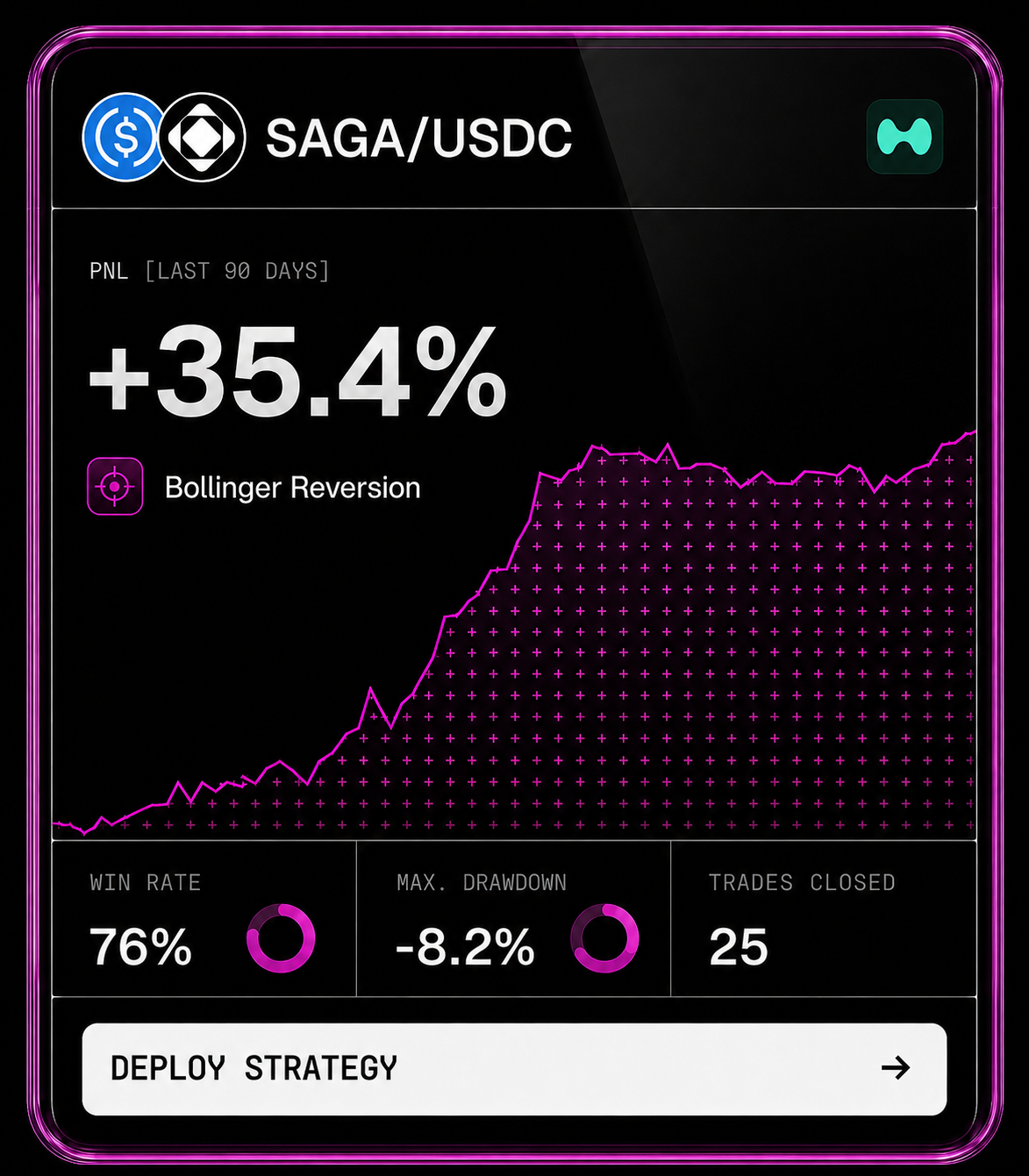
SAGA/USDC RSI Reversion
The SAGA/USDC setup shown here applies this approach on a 15-minute timeframe. Ethy monitors SAGA's RSI and price conditions continuously, looking for mean-reversion opportunities and automatically managing trades when the strategy's rules are triggered.
Over the displayed 90-day period, this setup recorded a +32.3% return across 24 trades, with a 75% win rate and -8.4% maximum drawdown.
Past performance does not guarantee future results.
2. DIP in Uptrend on $EIGEN
Best for: Buying short-term pullbacks while the broader trend remains bullish.
Dip in Uptrend is designed around the idea that not every price decline represents the same opportunity. Instead of buying every dip, the strategy looks for short-term weakness within an established uptrend, helping distinguish temporary pullbacks from assets that may be entering a larger decline.
Rather than manually tracking multiple indicators and timeframes, the strategy can be automated to wait until both the pullback and broader trend conditions align before entering a position.
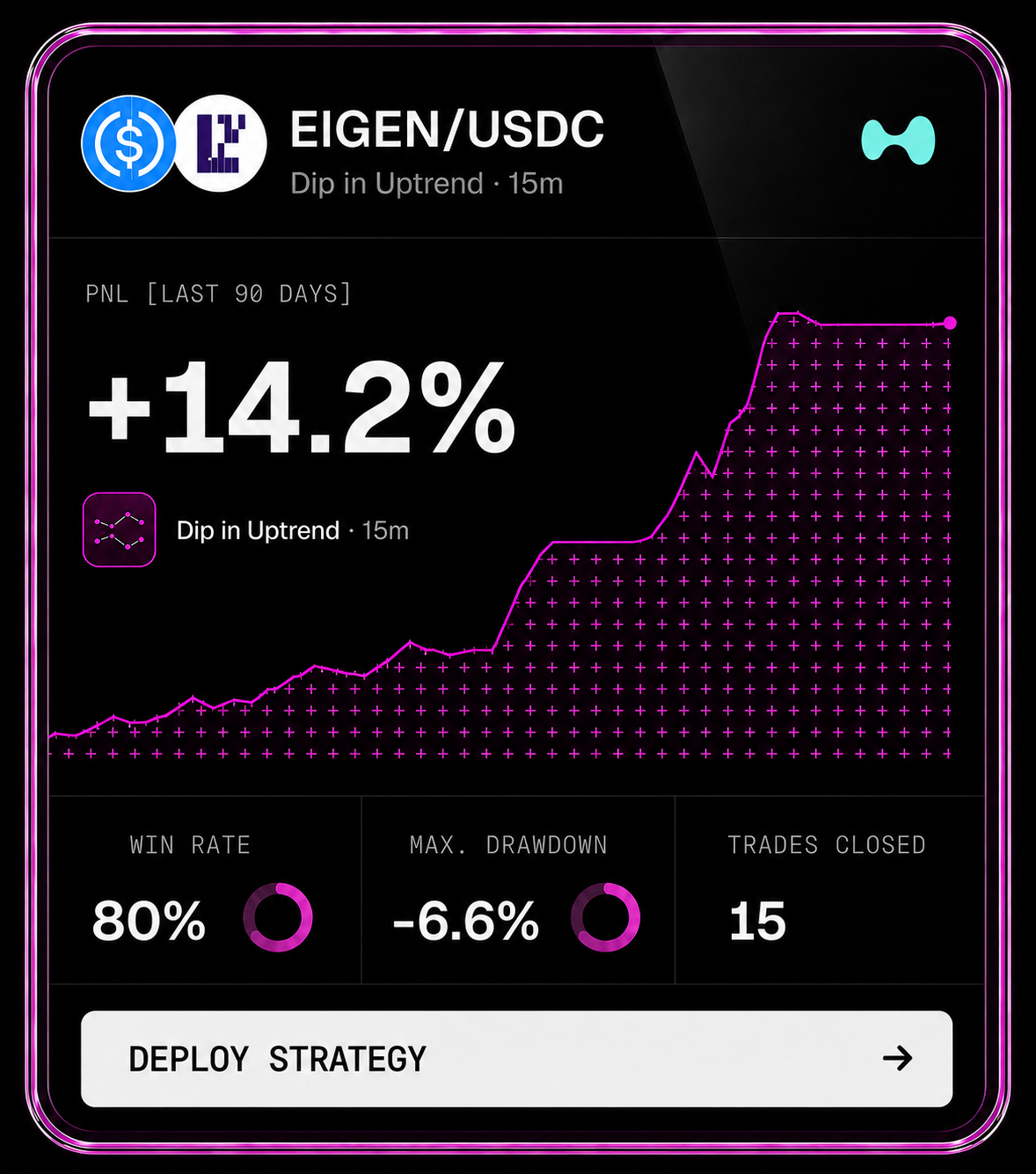
EIGEN/USDC Dip in Uptrend
The EIGEN/USDC setup shown here applies this approach on a 15-minute timeframe. Ethy waits for the fast RSI to move into oversold territory, but only enters while the higher-timeframe trend remains bullish, confirmed by the EMA20 staying above the SMA50. The strategy exits when RSI recovers past 55, with take-profit and stop-loss conditions managing the position throughout.
Over the displayed 90-day period, this setup recorded a +14.2% return across 15 trades, with an 80% win rate and -6.6% maximum drawdown.
Past performance does not guarantee future results.
3. Bollinger Reversion on $NVDA
Best for: Trading price overextensions in ranging or mean-reverting markets.
Bollinger Reversion is based on the idea that when price stretches unusually far from its recent average, it may eventually revert toward the mean. Bollinger Bands create a volatility envelope around price, helping identify these statistically stretched moves rather than relying on a fixed price threshold.
Instead of manually watching for these overextensions, the strategy can be automated to monitor when price moves beyond the lower Bollinger Band and act when its predefined conditions are met.
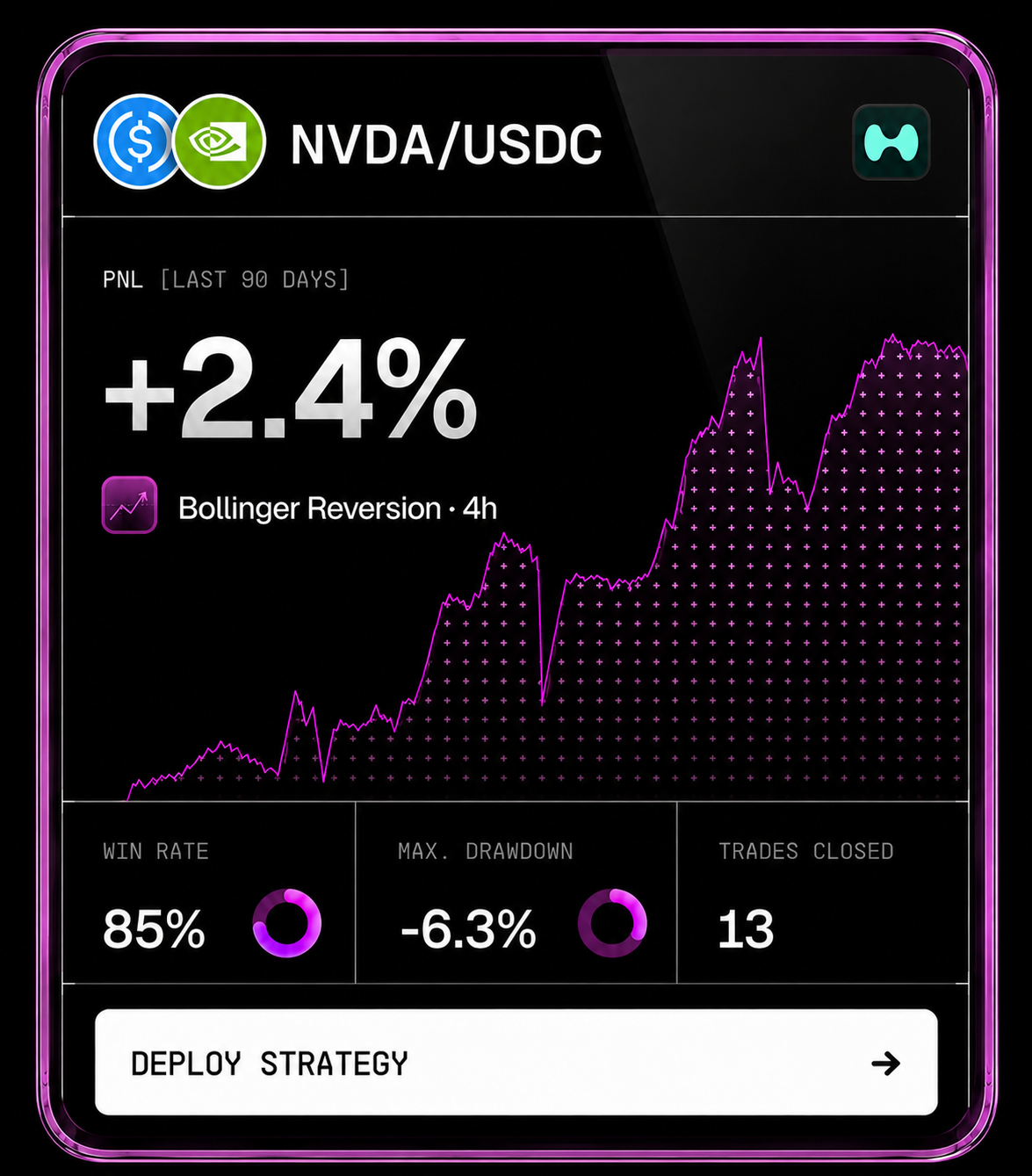
NVDA/USDC Bollinger Reversion
The xyz:NVDA/USDC setup shown here applies this approach on a 4-hour timeframe. Ethy enters when price closes below the lower Bollinger Band, targeting an overextended move, and exits when price recovers toward the middle band. A stop-loss helps protect the position when the move develops into a sustained breakdown instead of reverting to the mean.
Over the displayed 90-day period, this setup recorded a +2.4% return across 13 trades, with an 85% win rate and -6.3% maximum drawdown.
Past performance does not guarantee future results.
4. M/A Cross (Golden/Death) on $BTC
Best for: Following sustained market trends and capturing larger directional moves.
The Moving Average Cross strategy uses two moving averages with different speeds to identify shifts in market momentum. When the faster EMA crosses above the slower one, known as a Golden Cross, it signals that momentum may be turning bullish. When it crosses back below, known as a Death Cross, it suggests momentum may be shifting bearish.
Instead of manually watching for these crossovers candle by candle, the strategy can be automated to identify each signal and adjust the position as the market trend changes.
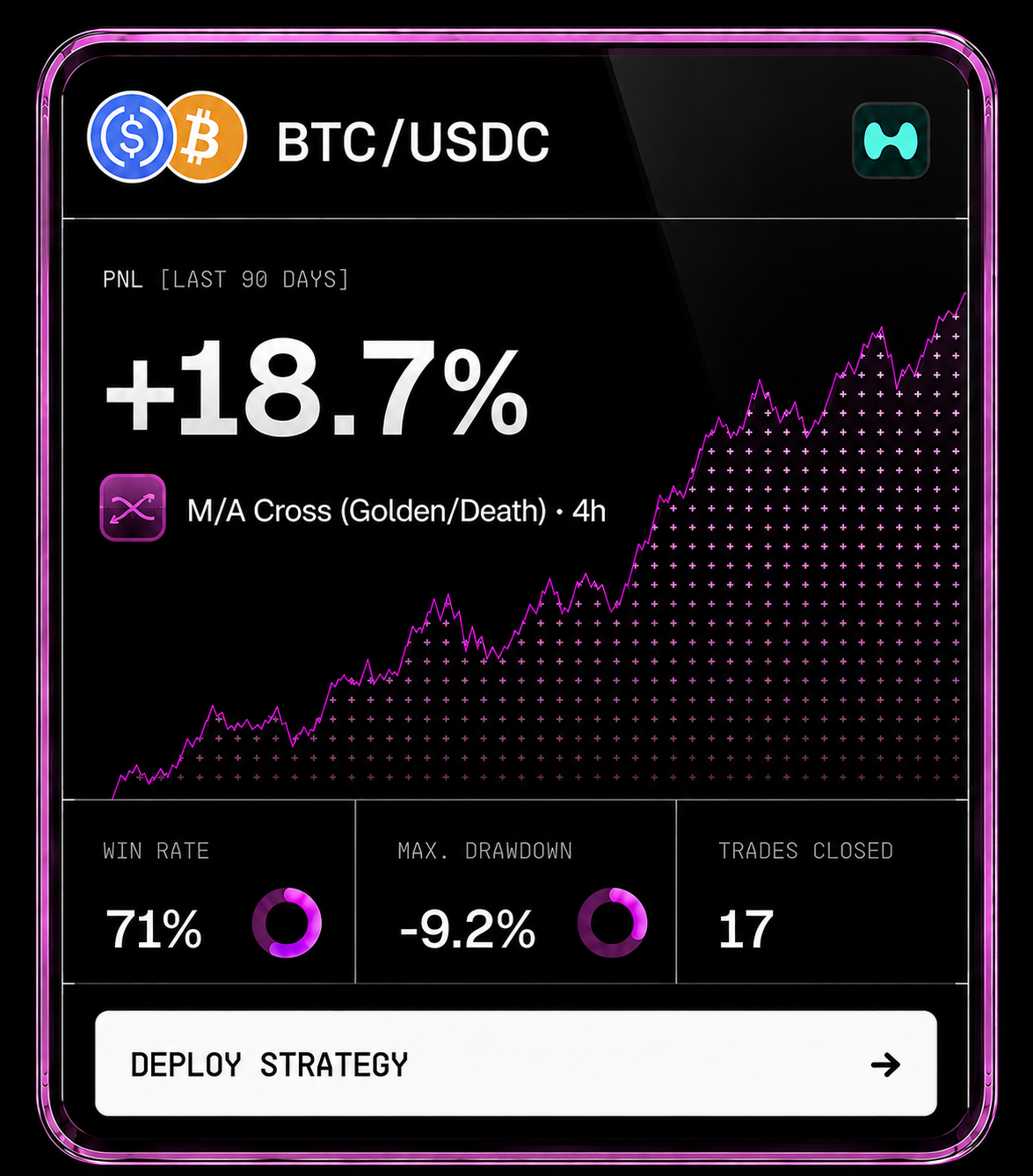
BTC/USDC M/A Cross (Golden/Death)
The BTC/USDC setup shown here applies this trend-following approach automatically. Ethy monitors the fast and slow moving averages continuously, entering when a Golden Cross signals bullish momentum and exiting or reversing when a Death Cross signals a bearish shift. On perpetual markets, the strategy can switch between long and short positions, allowing it to follow sustained moves in either direction.
Over the displayed 90-day period, this setup recorded a +18.7% return across 17 trades, with a 71% win rate and -9.2% maximum drawdown.
Past performance does not guarantee future results.
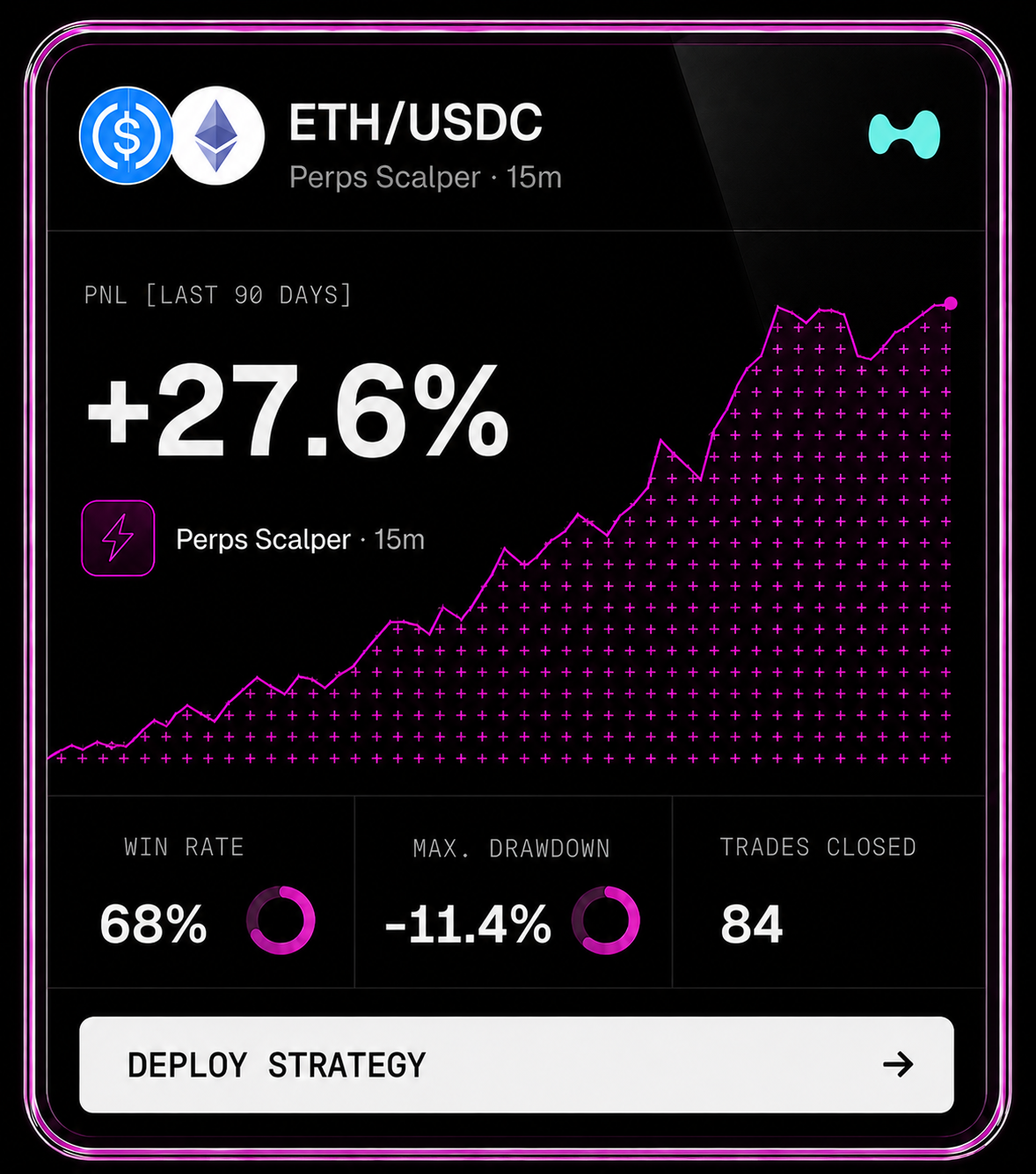
5. Perpetuals Scalper on $ETH
Best for: Capturing frequent short-term moves during periods of high volatility.
Perpetuals scalping focuses on taking many small, fast trades rather than waiting for a few large market moves. The strategy uses short-timeframe signals to identify brief changes in momentum or temporary price overextensions, opening leveraged positions and closing them quickly as those opportunities play out.
Because these signals can appear and disappear within minutes, the strategy is particularly suited to automation. Instead of watching every candle manually, the agent can continuously monitor ETH, execute when its conditions are triggered and apply disciplined risk management to every position.
ETH/USDC Perpetuals Scalper
The ETH/USDC setup shown here applies this approach on short 5- and 15-minute timeframes. Ethy monitors fast-moving signals such as EMA crossovers, RSI conditions and Bollinger Band reversions to identify short-term opportunities. Depending on the signal, the strategy can take both long and short leveraged positions, while tight stop-loss conditions limit exposure when a trade moves against it.
Over the displayed 90-day period, this setup recorded a +27.6% return across 84 trades, with a 68% win rate and -11.4% maximum drawdown.
6. Momentum Breakout on $CASHCAT
Best for: Capturing explosive price moves in highly volatile markets.
Momentum Breakout is designed to trade strength rather than wait for a pullback. The strategy looks for a sharp price move over a short period and uses momentum indicators such as RSI to confirm that the breakout has genuine strength behind it without already being exhausted. Once confirmed, it enters with the expectation that momentum can continue.
Instead of using a fixed profit target, the strategy can be automated to follow the move with a trailing stop, allowing strong breakouts to keep running while progressively protecting gains. A hard stop-loss helps manage the false breakouts that quickly reverse after entry.
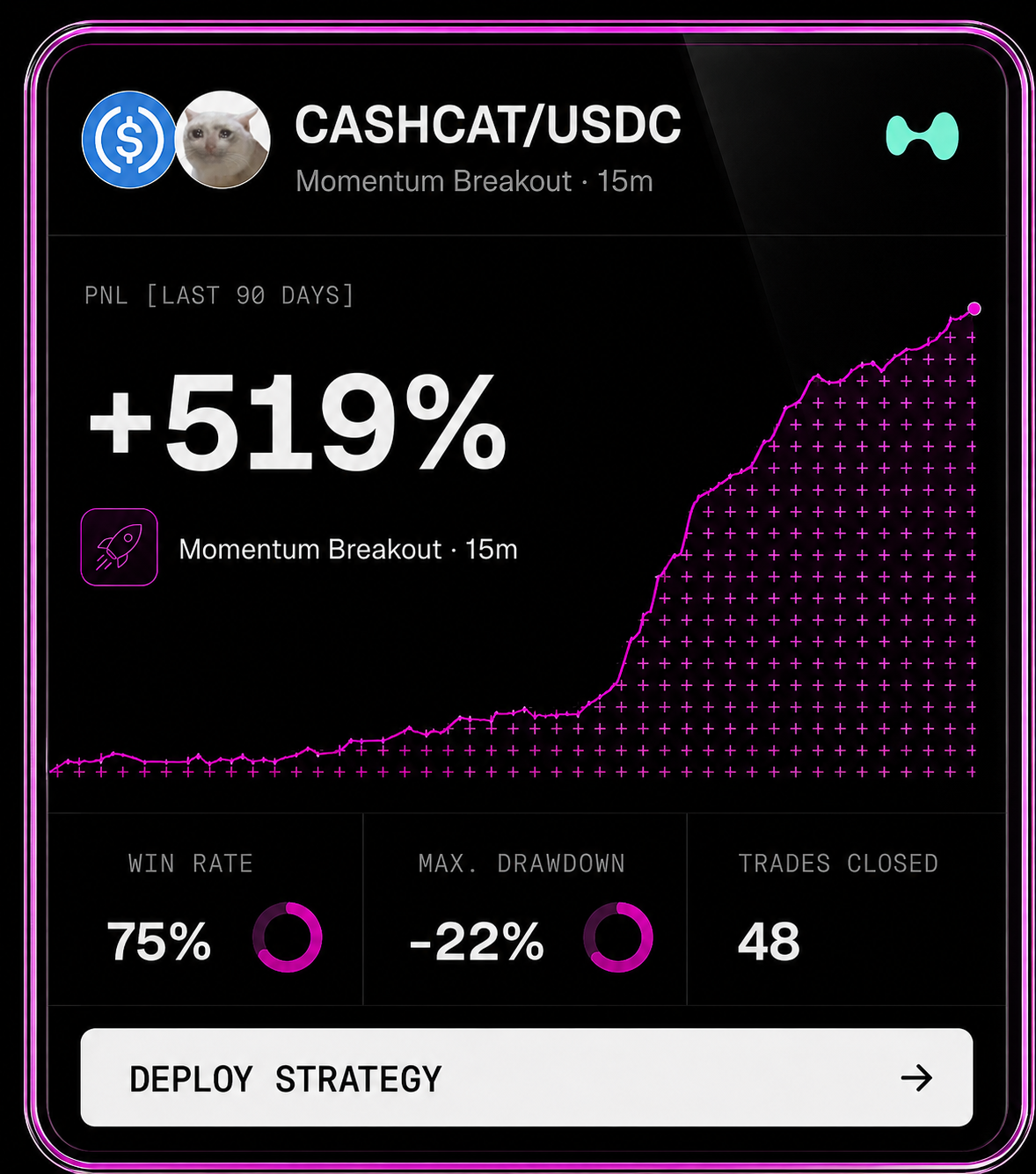
CASHCAT/USDG Momentum Breakout
The CASHCAT/USDG setup shown here applies this aggressive approach to a highly volatile memecoin market. Ethy continuously monitors CASHCAT for sudden price expansions and enters when the breakout and momentum conditions align. Once in the position, a trailing stop follows price higher rather than immediately taking profit, allowing unusually strong moves to run while automatically exiting when momentum begins to reverse.
Over the displayed 90-day period, this setup recorded a +519% return across 48 trades, with a 75% win rate and -22% maximum drawdown.
Past performance does not guarantee future results.
Which Hyperliquid strategy is best?
There isn't a single Hyperliquid strategy that works in every market. The setups above are examples of different approaches traders can automate depending on the asset, market conditions and their own trading preferences.
With Ethy, traders aren't limited to these strategies. They can create their own setups using the assets, indicators, conditions, timeframes and position sizes they choose, from simple single-condition automations to more advanced strategies combining multiple signals.
Before putting capital to work, a strategy can be backtested against historical market data to understand how it would have performed under previous conditions. Traders who already know what they want to run can instead deploy their strategy directly and let Ethy execute it automatically.
For those who don't want to build a strategy from scratch, Ethy also allows users to copy proven strategies that are already live, review their track record and deploy them for themselves.
Ultimately, the question isn't only which Hyperliquid strategy is best. It's which strategy fits the market, asset and level of risk you want to trade, and whether you want to build it yourself or start from something that's already working.
This is much stronger IMO because after showing all those cards, the takeaway becomes:
These aren't the strategies Ethy offers. These are examples of what you can do with Ethy.
And that distinction makes the product feel dramatically more open-ended.
Why automate Hyperliquid strategies?
Manual trading works well when monitoring one or two markets.
Automation becomes valuable because it allows traders to:
- Monitor multiple Hyperliquid markets simultaneously.
- Execute without emotional bias.
- Never miss opportunities while away from the screen.
- Run strategies continuously.
- Apply the same rules consistently.
Rather than replacing the trader, automation allows the trader's strategy to operate around the clock.
Conclusion
There is no single "best" Hyperliquid strategy. The right approach depends on your objectives, risk tolerance and market conditions.
The biggest advantage many traders gain today isn't necessarily discovering a new strategy; it's automating proven ones. Whether you're accumulating over time, trading momentum or combining multiple indicators, automation allows those strategies to run consistently without requiring constant manual attention.
Frequently Asked Questions
Which Hyperliquid strategy is best for beginners? Dollar Cost Averaging is generally considered the simplest strategy because it removes the pressure of timing market entries.
Can Hyperliquid strategies be automated? Yes. Many strategies such as DCA, RSI Reversion, Grid Trading and Momentum trading can be automated using trading bots or AI trading assistants.
What's the difference between a trading strategy and a trading bot? A trading strategy defines what should happen. A trading bot or AI trading assistant is the software that executes that strategy automatically.
Can AI improve Hyperliquid trading strategies? AI doesn't guarantee better performance, but it can help traders automate complex multi-condition strategies, monitor many markets simultaneously and execute consistently without emotional bias.





.svg)
Your AI trading assistant.
Working 24/7 so you don't have to.

.svg)